
Sex With Vaginismus: Positions, Pacing, and What Actually Helps
By Jake Turner · Senior Editor · December 2025
Vaginismus — involuntary pelvic floor muscle contraction that makes penetration painful or impossible — affects an estimated 1–17% of women globally, depending on how it’s defined and measured. Despite how common it is, most people take years to get an accurate diagnosis. This guide covers what vaginismus actually is (hint: it’s a reflex, not a choice), and which positioning strategies help during treatment and gradual reintroduction of penetration.
In This Article
What Vaginismus Actually Is
Vaginismus is an involuntary contraction of the pelvic floor muscles — specifically the pubococcygeus and related muscles — in response to attempted vaginal penetration. It’s a reflex response, not a voluntary choice and not a sign of not wanting sex. The contraction makes penetration painful, uncomfortable, or physically impossible. It exists on a spectrum from difficulty with certain objects to inability to use tampons. The NHS’s overview of vaginismus provides a clear clinical description. Primary vaginismus (present from the first attempt at penetration) and secondary vaginismus (developing after a period of pain-free penetration, often after trauma, infection, or childbirth) require somewhat different treatment approaches but share the core mechanism.
Vaginismus often co-occurs with vulvodynia (chronic vulvar pain) and dyspareunia (painful intercourse from other causes) — conditions that overlap but are clinically distinct. See our related article on pelvic pain and positioning for additional context.
The Treatment Path: What Works
The primary evidence-based treatment for vaginismus is pelvic floor physiotherapy — specifically, progressive relaxation and desensitization work, often combined with dilator therapy. This is not the same as Kegel exercises (which strengthen pelvic floor muscles — the opposite of what vaginismus requires). A pelvic floor physiotherapist works on releasing hypertonic (overly tight) muscle patterns through internal and external techniques. The Pelvic Rehab practitioner directory is a good starting point for finding a qualified specialist. Cognitive-behavioural therapy addressing the anxiety component is also supported by the evidence, particularly for primary vaginismus with strong anticipatory anxiety.
Positions That Help During Recovery
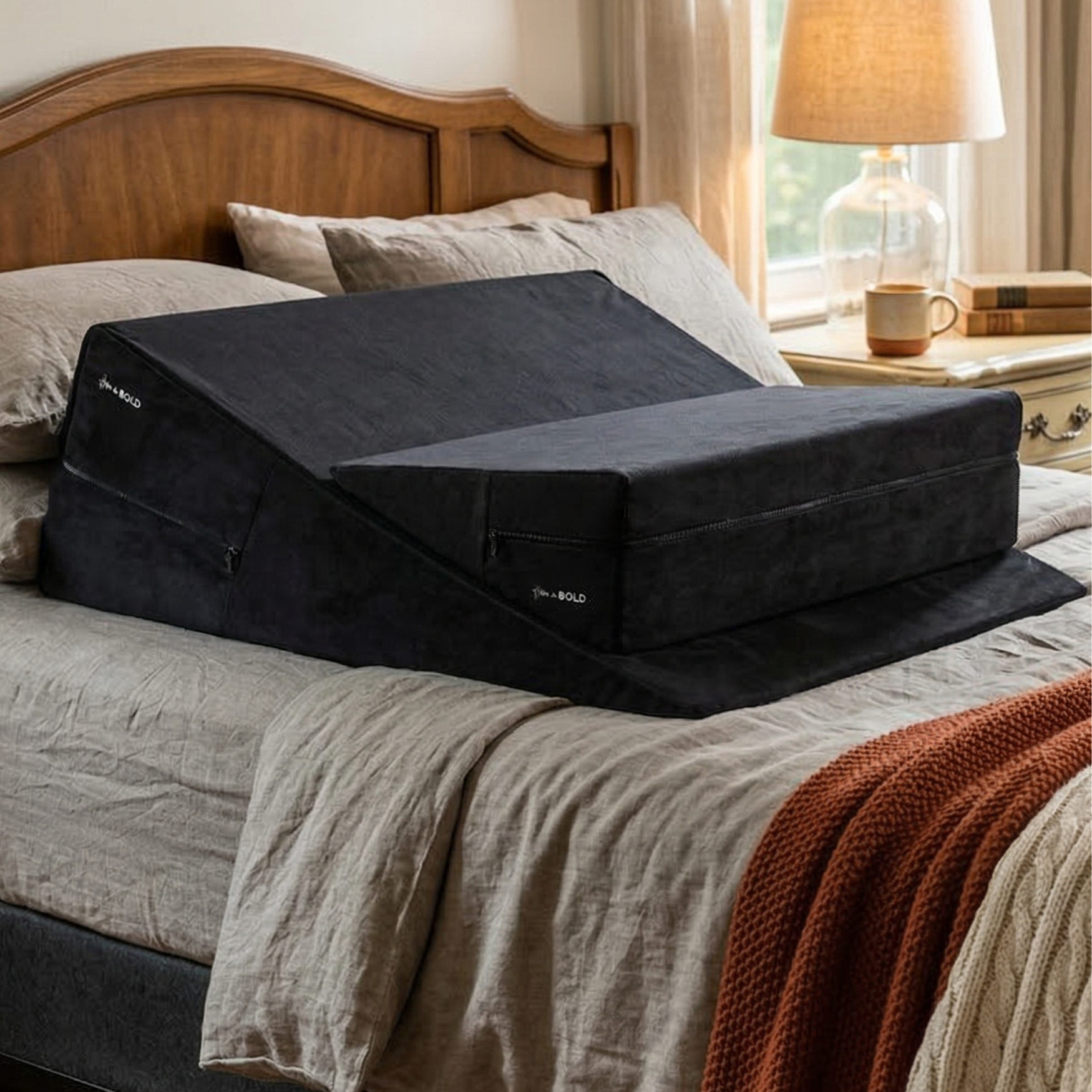
During treatment and gradual reintroduction of penetration, receiver-on-top positions are consistently recommended because they give the person with vaginismus complete control over depth, speed, and angle. When the person experiencing vaginismus controls all penetration variables, the anticipatory anxiety that triggers the spasm reflex is significantly reduced. A positioning wedge under the receiving partner’s knees or hips in a reclined position provides comfortable support during slow, self-controlled penetration attempts, removing the need to maintain a physical posture on top of managing anxiety and sensation. The key is removing every unnecessary source of effort or discomfort from the experience.
The Role of Control and Angle in Reducing Spasm
Pelvic floor spasm in vaginismus is often angle-dependent — certain entry angles trigger more spasm than others. Many people find a slightly downward-tilted entry angle (achieved by tilting the pelvis forward rather than back) less triggering than a straight or upward-tilted angle. A wedge allows this adjustment without physical strain, which matters because muscle tension anywhere in the body can exacerbate pelvic floor tension. The entire system relaxes more readily when the body is supported, warm, and not working hard to maintain a position. This principle underlies the use of positioning aids alongside dilator therapy in pelvic floor physiotherapy practice.
| Approach | Receiver Control | Effort Required | Recommended in Recovery |
|---|---|---|---|
| Standard missionary (partner on top) | None | Receiver passive | No — removes control |
| Cowgirl (receiver on top, no support) | Full | High (sustained balance) | Partial — tiring |
| Partner penetrating from side | Medium | Low | Sometimes helpful |
| Dilator practice (solo) | Full | Low | Yes — core of treatment |
| ⭐ Cowgirl with wedge support under knees/hips | Full | Very low | Yes — our recommendation |
See the Wedge & Ramp Combo on Amazon
Never push through pain with vaginismus. The goal during treatment is zero pain — any activity that causes pain reinforces the spasm-pain-anxiety cycle rather than breaking it. Progress is gradual by design, not a failure of effort.
Related Articles
Our Pick: Wedge & Ramp Combo Set
Receiver control · comfortable support · reduces effort during recovery
Frequently Asked Questions
Jake Turner
Senior Editor · GloryHoleToGo
Jake has spent over a decade reviewing sexual wellness products, positioning aids, and intimacy furniture. His recommendations draw on hands-on product testing, consultation with certified sex therapists, and analysis of thousands of verified buyer reviews.